Archives: Resources
Best Community Team Collaboration Software & Tools In 2025
Collaborate with your group online with the best online tools for beginners & advanced organisers What do I know about remote collaboration? I work with; and manage many collaborative teams working remotely including campaign groups, creative art groups and my own digital development company that operates 99% remotely. The people I work with come…
Email Response
Hello {Your Name:1} Thanks for getting in touch, let’s get the ball rolling! Before we speak to you over the phone, here are some useful things to know: We charge by the hour. This is particularly good news if you are working on a smaller budget as we can give you little nuggets of advice…
Please Note
Security is always changing so do some extra research yourself about recommended tools.The safety of tools can change suddenly if we learn of new exploits or risks with tools. Sometimes great tools get sold to dodgy corporations. Please use these recommendations in context with some healthy cynicism and common sense.
Webinar discussing this content and tools
2 hour discussion on the content of previous guide published in 2020.

Ten quick and easy things to radically improve your digital privacy and security
If this guide feels like too much, start with these 10 things.
Email list management
Should be self-hosted somewhere overseas. The servers hosting the email list management software contain the list of all email subscribers. Ideally, all subscribers should use a brand-new email account solely dedicated for receiving emails from the email list.
Document Collaboration
Crypt pad is realtime Collaborative docs simplar to google docs. Due to its secure nature it laks an easy way to group documents, requiring the need to create and manage an inventory of the secure URLs. You can also use a desktop text or document editor and share by encrypted channel (not realtime)
Video conferencing
We are looking for a better option for video conferencing. It is important to know that regular phone conversations or popular VoIP tools like Skype or Google Hangouts have wiretapping capabilities built-in. Authorities can request Microsoft to record and hand over conversations with a warrant.
Lock your computer and phones. Review security settings
Turn on auto-screen lock features using passwords and 2FA. Facial recognition lock can be unlocked by police using your face (same with fingerprint). Turn the phone off if police are likely to confiscate it as this makes it much harder for them to break into a phone before it has been logged into for the…
Private Internet – Anonymous Connection
You could use a public wifi but be careful and use a VPN as they are insecure and can be used to hack you. You can also order an overseas SIM online with Australian data roaming – that doesn’t require ID.
Private Internet – Tor – Anonymous Browsing
Bounces internet users’ and websites’ traffic through “relays” run by thousands of volunteers around the world, making it extremely hard for anyone to identify the source of the information or the location of the user. Use tor with your VPN and ideally with a secure OS and burner laptop. Unfortunately Tor can slow your internet…
Private Internet – Stop using Google and FaceBook (so much)
Treat Google and Facebook like “Junk Food” and seek to limit your consumption
Private Internet – Block ads and trackers
Minimise browser plugins as some have built in trackers. Cookies are stored in your browser to personalise your experience on websites and are also used to track you. Delete these regularly (every time you quit) to reduce their ability to build a profile on you. In Brave/Chrome > clear browsing data > on exit.
Private Internet – VPN – Virtual private network
A VPN works by connecting your computer (using encryption) to another computer located somewhere else in the world. Your access to the internet then comes from that computer located somewhere else in the world. So if the computer is located in France, then you are surfing from France. The mandatory data retention scheme implemented by…
MFA – Multi-factor authentication
Sometimes called Two factor verification. This provides multiple methods to verify yourself in addition to your usual login user and password which vastly improves your security while using online apps and websites. MFA apps are the recommended approach as the Common approaches of SMS or email codes could be spoofed or hacked.
DNS Name records
Subset of DNS Dynamic name serves control th edomain Name records control the parts of the domain Custom email (mx records) Registering email for spam filters Registering with google Redirecting sub-domains
Caching and Content Delivery Networks
Caching solutions such as cloudflare can offset an issues with location of servers as they have multiple servers and serve from local location.


Introduction to media planning
Gain the maximum exposure with your resources by planning your media systems
Example media plan for a protest event
This document was the proposed media plan for the #ClosePineGap protest event. This plan is based on consensus structures used for frontlineaction.org and reefdefenders.net
Convenience VS Security
Some security technologies can be less than convenient. Typing long passcodes into your phone and surfing with slower internet speeds via tor. It is up to you how much you balance security and convenience. Many security approaches and technologies do not impact on convenience so apply as many security lessons as you practically can.


Action Photo Coordinator
During an action or event, this role manages photos from the on site photographers, processes the images and uploads them so they are accessible for the media and social media
Secure Email
Google and similar tools are not encrypted: authorities can request the hosting companies to hand over your data. Secure email can be simplified by your group using only one email service such as riseup, tutanota, or protonmail. This means the “end to end” (from your email to your friends email) encryption is managed by the…

Databases and CRMs
(In our context ) A database is a collection of information on people. A CRM (Client Relationship Manager) is a specialised database for managing people’s information, interactions and relationships with people. As database tools become more advanced, we are increasingly building up a lot of information so we need to pay special attention to privacy…
Phones and laptops in meetings
Microphones and cameras can be remotely activated without you knowing and can be switched on remotely. Good practice is to gather all devices and remove them from meetings. Even if they have dead batteries, this encourages good security culture. Some people place tape over their laptop camera because someone watching you remotely is creepy.
Security Culture – working in groups
Security culture is an agreement made by a group which outlines the minimum security, tools and security processes the group will use. This allow individuals to understand their personal risk as well as the risk to the group and the groups actions.
Setting up an Activist Camp
Notes from Camp Meeting Tabulam. Workshop content by Murray Muzz Drechsler
Remote Group collaboration – working online
Slack, Google and similar tools are not encrypted: authorities can request the hosting companies to hand over the documents, user list and the chat logs. Nextcloud is a secure replacement for the google collaboration ecosystem
Antivirus and scanners
We have been discussing Antivirus and specifically this article: Do You Even Need Antivirus Software in 2024 Apple and Microsoft Defender are now just as good as the anti-virus software. Installing anti-virus brings privacy risks as the application has so much access to your computer. This is a big change for us Updating this guide…
Advanced anonymous internet
So you want to be a ninja online? Like martial arts to be truly invisible online you need to spend a lot of time becoming an expert in the technology. There are no shortcuts to becoming a martial arts ninja but there are some ways to skill up without being a top level security geek.
Location and tracking
Your location is being tracked and recorded via your mobile device. Many private companies are recording and selling this info. Many drone assassinations in the Middle East are targeted via the location of a persons mobile device.
Phone security
Phones have become very complex and usually ship with dodgy settings out of the box so the first and most important rule about modern smart phones is DON”T TRUST THEM. Make sure your are geek street smart. Here are some ways to improve your phone security.
Private internet – commerce
There are two major ways to buy things anonymously online. The first one is using Visa or Mastercard gift cards. These can be bought with cash at many supermarkets and at Australia Post. The other way is using the crypto-currency: Bitcoin. Please search for more information on the Bitcoin technology and how to use it.
Secure Phone communications
Anything encrypted is better. SMS and voice was built to be intercepted and recorded (since the paper telegram days). Apple messenger and Facetime are respected, however requires iphone. Older phones have lots of vulnerabilities – not recommended
Smart password mangement
Weak passwords are a primary way to hack you. Simple passwords can be broken by a “brute force attack” where average computers have enough resources to crack them reasonably quickly. YOU NEED A PASSWORD MANAGER
Encrypt all devices, drives and sensitive folders
Encrypting is usually a simple matter of turning encryption on via your devices settings. By enabling encryption you make hacking your device either impossible or very difficult and resource intensive.
Multiple backups
Your data can be lost in many ways: Fire, theft, failure, arrest, loss etc. You can also lose data if you apply some security measures incorrectly. Make sure you have adequate backups before you start securing and encrypting.
Update your software regular – apply updates
There is a constant loop happening: Hackers find exploits in software and the software people patch them up. Make sure you apply the latest versions to all your software including operating systems, apps and websites to ensure you have the latest secure versions. Unpatched software is a very common way to be hacked.
Digital literacy – learn your technology
Computers have given us powerful tools that also need maintenance and management. Learning the basics of how your computers and phones work, will make you far more savvy in understanding digital security
Who are we protecting from?
Security has many levels and protects you from different levels of spies. It is important to understand, the people more likely to target you are probably the least sophisticated. This means any improvement to your security will go a long way.
Don’t let Paranoia stop you organising
Although they come with risks, digital tools allow us to leverage our actions and communications in unprecedented ways. If we stop using the these tools due to security, we have lost before we have even started. Use the tools wisely. Some risks are involved but missing the big opportunities is a far bigger risk.
Be geek street-smart – Security is not perfect
High end security is very complex and can make using your technology less convenient. The aim of this guide is to implement good security and not perfect security. Unless you understand the technologies of a technical level, always assume your system is compromised and use your technology wisely. You may have perfect encrypted messaging but…
Encryption works – What is encryption?
Encryption involves using advanced mathematics to scramble your data, making it impossible to access without your key (password). The Snowden leaks has proven that encryption works and we can protect ourselves from spying.
Herd Immunity – My part in protecting everyone
If only a few people are protecting themselves they become targets, as it is assumed they have something worth spying on. When you and others start protecting themselves, then it gets very difficult and expensive to spy on everyone.
Why Secure myself? – I am not doing anything worth spying on
Many people believe that they are not worth spying on. There are many reasons to protect yourself and your community.
How to get a domain working with your website
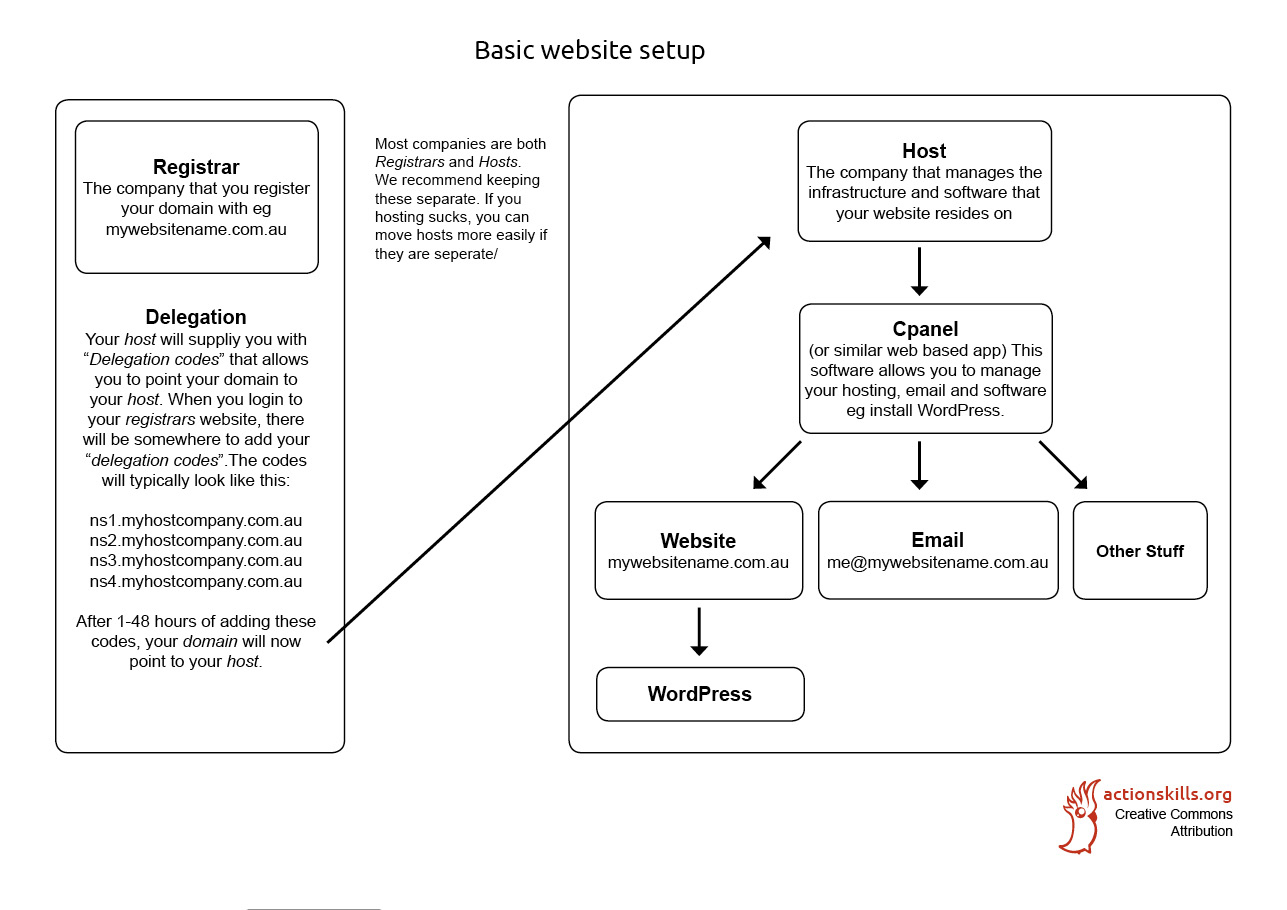
Once you have registered your domain you will need to set it up so that it works with your hosting. The domain needs to be “Delegated” by configuring the “DNS” (domain name server). This means the domain needs to be “pointed” to your host using the DNS codes. Usually your registrar and/or your host will…
Hosting – setting up email
The process of setting up your email varies across hosts. Your hosting company will provide you a management area where you login and set up your email. For more information, see Hosting – basic client tools
FTP – introduction
FTP is short for File Transfer Protocol. Your website is hosted on a machine somewhere on the internet (local or in another country). Within your hosting setup is your account that contains all your website files and data. This is a very similar setup to your own computer. So think of your account as your…